Consortium partners highlighted in Cell Systems special issue
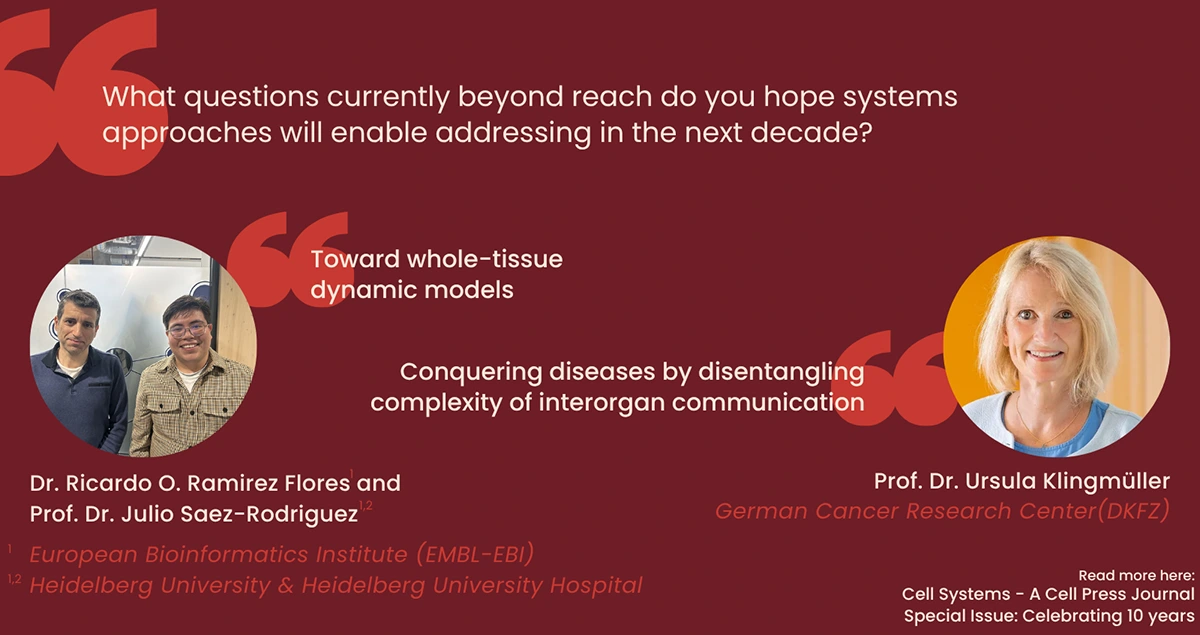
Prof. Dr. Ursula Klingmüller and Prof. Dr. Julio Saez-Rodriguez as well as his lab member Dr. Ricardo O. Ramirez Flores were interviewed as 'Voices' for the Cell Systems Journal special issue for their 10th anniversary.
The question to the Voices:
„What questions currently beyond reach do you hope systems approaches will enable addressing in the next decade?"
Response from Prof. Klingmüller:
"Conquering diseases by disentangling complexity of interorgan communication"
The maintenance of health and the prevention of disease are determined by a highly complex network of interactions occurring at multiple biological levels and involving different organs. Environmental exposure, including air pollution and nutrition, together with genetic predisposition affect these interactions to different degrees, resulting in highly heterogenous responses and in disease trajectories that are difficult to predict. Addressing this complexity requires the integrative collection of clinical data and high-quality patient samples across clinical disciplines, advances in high-throughput quantitative technologies and phenotypic response profiling, and the combination of AI-based approaches with mechanistic mathematical modeling. Together these developments foster the establishment of biomarker panels for model-based risk assessment of disease development in individual patients. As diseases are dynamic processes that can advance over years, longitudinal patient information has to be considered to gain insights into mechanisms determining dynamic behavior. This requires the standardized acquisition, processing, and sharing of multi-level clinical and molecular data, as well as the exploitation of diverse modeling strategies for the development of digital twins. These integrative modeling approaches are essential to reduce costs by enabling precision clinical trials and to develop clinical decision support systems that assist clinicians in providing optimized care for individual patients. Finally, actively involving patients in these efforts facilitates personalized surveillance, improves prevention and early detection of diseases, and empowers individuals to preserve health and quality of life.
Response from Ricardo O. Ramirez Flores and Prof. Dr. Julio Saez-Rodriguze:
"Toward whole-tissue dynamic models"
Systems biology has evolved alongside technological advances, particularly through the integration of increasingly rich information across modalities. Looking ahead, we expect spatially and temporally resolved single-cell and multimodal omics profiling to become available across organs and physiological contexts. A central question will then be whether we canconstruct whole-tissue dynamic models that explicitly capture how cells coordinate their behavior, as part of a collective system, through intercellular and intracellular signaling and regulatory processes. Such models would bridge scales andmergecell-intrinsic descriptions with tissue-level cellular coordination. In doing so, systems approaches could enable the study of the molecular processes involved in multicellular coordination and how disease or perturbations affect them. To achieve this, we foresee the development of multimodal modeling frameworks that explicitly account for the multicellular nature of tissues, while being constrained by prior knowledge of molecular and cellular interactions. These whole-tissue dynamic representations could help describe how tissues remodel and which molecular or cellular factors are associated with these changes.
Read more about the other Voices here:
https://www.cell.com/cell-systems/fulltext/S2405-4712(26)00022-0